Lattice bench: the rigs we built for ourselves, made for your lab.
Multi-channel acquisition and device test benches with calibration you can trace, timing you can trust, and data you can open in whatever you already use.
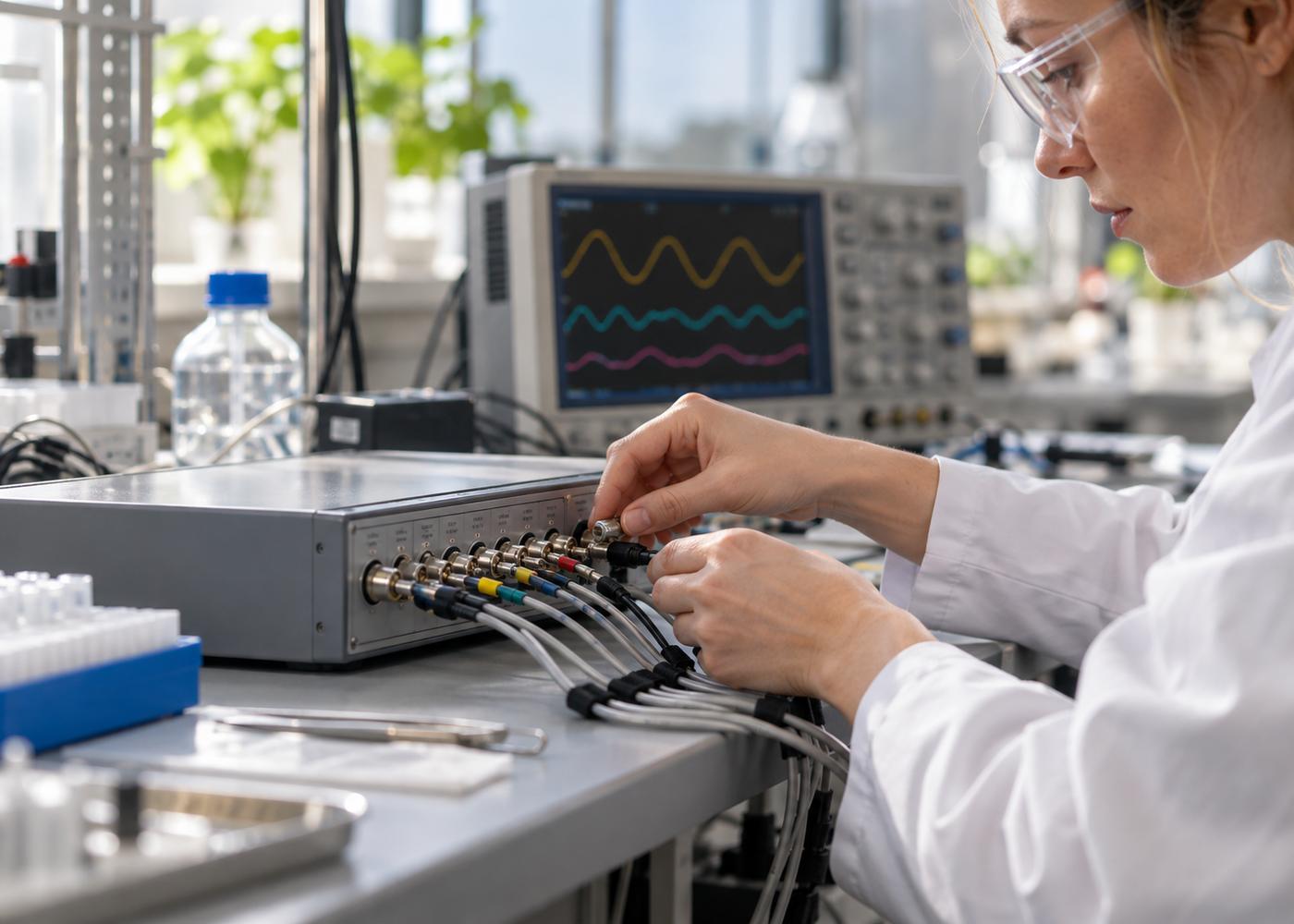
What research groups ask us for
Usually in a grant application, often with a deadline.
Provenance with every file
Which channel, which calibration, which firmware, which clock. The same metadata we attached to the open ECG dataset.
Synchronized channels
Signals from several instruments on one time base, so a lag in the analysis is a finding and not an artifact.
Open formats
EDF+, Parquet and HDF5 out of the box. No proprietary viewer standing between you and your data.
A bench that outlasts the grant
Five-year support as standard and a firmware base we maintain for our own use anyway.
Configurations
Two sizes, and a test variant used by device makers.
Lattice Bench LB-8
Eight differential channels for physiology labs and teaching.
- 24-bit, up to 16 kHz per channel
- Two auxiliary inputs for triggers and markers
- USB-C and Ethernet
Lattice Bench LB-32
Thirty-two channels for multi-modal studies.
- 24-bit, up to 32 kHz per channel
- Hardware time-stamping to 1 microsecond
- Cascades to 128 channels across four units
Lattice Bench LT
A device test bench: signal playback, simulated patients and automated pass/fail scoring.
- Plays recorded physiology into a device under test
- Scores device output sample by sample
- The same scoring our chamber tests use
Lattice Bench Studio
Desktop software for acquisition, review and export.
- Windows and Linux
- Python and MATLAB-compatible export
- Scriptable acquisition protocols
Specifications
Current production model. Full detail is in the instructions for use.
| Specification | Value |
|---|---|
| Channels | 8 (LB-8) or 32 (LB-32), cascading to 128 |
| Resolution | 24-bit |
| Sample rate | Up to 32 kHz per channel (LB-32) |
| Timing | Hardware time-stamps to 1 microsecond; PTP and external clock input |
| Calibration | Traceable certificate per unit, annual recalibration in Saint Paul |
| Formats | EDF+, Parquet, HDF5, raw binary with an open reader |
| Operating system | Lattice OS 4 |
| Support | Five years from date of shipment |
The first bench we bought was to replace three instruments. The reason we bought the second was the calibration record.
Dr. Naomi Achterberg
Cardiovascular research group, Cascade University
Works with
For labs that pair the bench with wearables in the field.
Axon Sense
Ambulatory recording outside the lab.
API and developer docs
Scripting acquisition and pulling data.
Training
Bench operator and calibration courses.
Firmware updates
Current Lattice bench firmware and its release notes.
Product support
Phone lines, severity levels, and what to have ready.
Recalls and advisories
Every field safety notice and software advisory we have issued.
Writing a grant?
We will send a quotation, a specification sheet and a data management statement in the format most funders ask for.