Corta: the rhythm record for the episode that never happens in clinic.
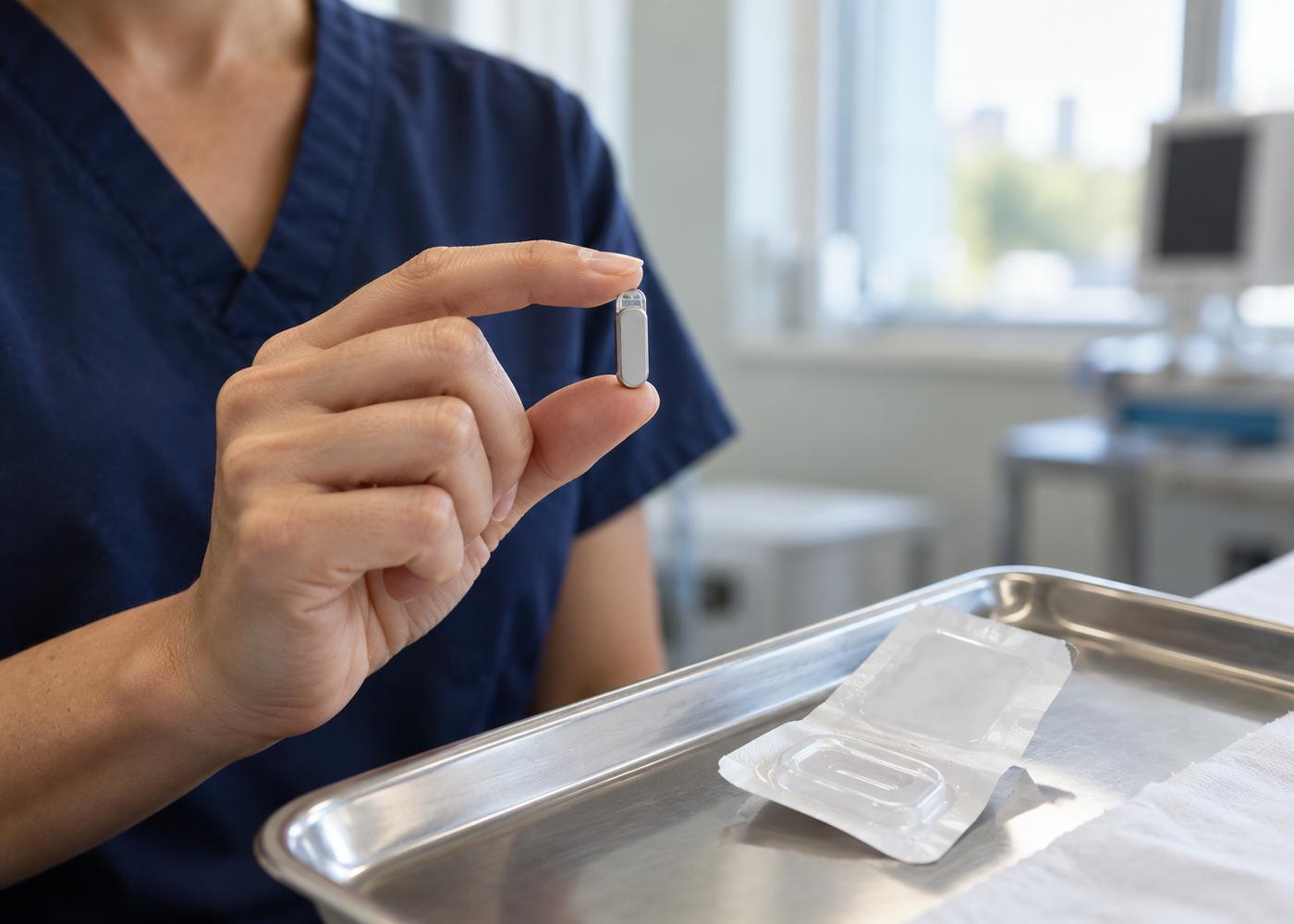
A monitor smaller than a paper clip, placed under the skin in a ten-minute procedure, and a bedside reader that sends its data on every night.
The problem it solves
Some rhythms show up twice a year. A two-week patch will miss them.
Rare episodes
Unexplained fainting and palpitations often come months apart. The monitor has to be there when it happens, which means it has to stay for years.
Nobody presses a button
Corta detects and stores episodes automatically. A patient who has just fainted is not the person to rely on for an event marker.
Clinic visits to read a device
Older implantable monitors waited for the next appointment. Corta's reader sends data overnight, so a stored episode reaches the team the next morning.
Alert fatigue
Every detection algorithm has false positives. Corta sends the strip with the alert, so a technician can dismiss a bad one in seconds.
What is in the system
Three parts, one of which the patient never sees.
Corta monitor
An insertable cardiac monitor with a three-year battery, placed just under the skin of the chest.
- Continuous single-lead ECG
- Automatic detection of pause, bradycardia, tachycardia and atrial fibrillation
- Patient-activated recording with the Corta key fob
Corta bedside reader
A small unit that sits by the bed, plugs into the wall, and reads the monitor while the patient sleeps.
- Cellular connection built in; no home internet needed
- Reads automatically within 2 m
- Holds 30 days of data if the network is down
Corta clinic view
Episodes, strips and device status inside Formcloud, or delivered into the clinical record.
- Triage queue sorted by urgency
- Strip review with annotation
- FHIR Observation and DiagnosticReport output
Insertion kit
Single-use, sterile, with the tools for a ten-minute office procedure.
- Pre-loaded insertion tool
- Incision and closure supplies
- Patient ID card and reader pairing code
Specifications
Current production model. Full detail is in the instructions for use.
| Specification | Value |
|---|---|
| Monitor volume | 1.1 cc |
| Battery longevity | Up to 3 years |
| Episode storage | 60 minutes of ECG across stored episodes |
| Detection | Pause, bradycardia, tachycardia, atrial fibrillation; thresholds set per patient |
| Reader connection | LTE-M cellular, with Wi-Fi as a fallback |
| Reading range | Up to 2 m from the bedside reader |
| MRI | MR conditional; conditions are listed in the instructions for use |
| Clinic delivery | Formcloud clinic view, HL7 ORU, FHIR R4 |
Two years of 'probably nothing' ended with a forty-second strip. That strip is why he is back on the ice.
Dr. Samuel Okafor
Pediatric electrophysiologist, Great Lakes Health Children's
Works with
The monitor is the small part. These are the rest.
Formcloud
Where the clinic view and device status live.
HL7 and FHIR integrations
Delivering episodes into the cardiology record.
Accessories
Insertion kits, key fobs and replacement readers.
Firmware updates
Current Corta reader firmware and its release notes.
Product support
Phone lines, severity levels, and what to have ready.
Recalls and advisories
Every field safety notice and software advisory we have issued.
Running a device clinic?
We can show you what a week of Corta triage looks like for a clinic your size, using sample data rather than a slide.